Cleveland’s police consent decree could end, and critics are furious
Updated: Feb. 20, 2026, 4:40 p.m. | Published: Feb. 20, 2026, 4:27 p.m.
By Olivia Mitchell, cleveland.com and Advance Local Express Desk
CLEVELAND, Ohio — As Cleveland officials push to end nearly 11 years of federal oversight of the city’s police department, critics say the move may be premature — and potentially risky.
The federal consent decree was imposed in 2015 following a U.S. Department of Justice investigation that found a pattern of excessive force within the Cleveland Division of Police. On Thursday, the city and the DOJ, filed a joint motion to terminate the decree. But at a hearing Friday, U.S. District Judge Solomon Oliver Jr., who oversees the agreement, did not rule on whether to end it, leaving its future in question for now.
Ayesha Bell Hardaway, a law professor at Case Western Reserve University and former federal monitor of the Cleveland police consent decree, argues that while progress has been made, the city has not yet demonstrated the comprehensive, sustained reform required to exit court supervision.
“This consent decree requires far more than positive use-of-force numbers,” Bell Hardaway said. “It was designed to fix structural problems that led to unconstitutional policing in the first place.”
City cites progress
The motion isn’t exactly out of the blue. Mayor Justin Bibb previously signaled his desire to bring the city out from under federal oversight.
Two weeks ago, Police Chief Dorothy Todd and Dr. Leigh Anderson, who leads the city’s Police Accountability Team, said reform efforts have accelerated after what they described as a lengthy period of stalled progress.
According to the latest report from the independent Federal Monitoring Team, 97% of level one and level two use-of-force incidents in 2024 were deemed constitutional. Those are non-lethal situations in which police don’t fire guns. The department sought to improve across multiple categories, including use of force, crisis intervention, search and seizure, recruitment and hiring, staffing, equipment and training.
However, the report also flagged areas of concern. Overall use-of-force incidents increased in 2024, particularly those involving violence toward officers and obstruction of justice. Injuries to members of the public also rose compared to the previous year.
‘Three out of eight is not passing’
Bell Hardaway said the city’s motion highlights progress in only three of the decree’s eight major reform areas: search and seizure, use of force and crisis intervention. In total, the eight reform areas include 18 subparts.
“If we look at this simply through use-of-force compliance, then we’ve missed the point about why the consent decree was necessary,” she said. “Three out of eight is not passing.” She stressed that the decree requires not only compliance, but sustained compliance over time —something she believes has not yet been demonstrated.
Bell Hardaway, who previously served as the interim federal monitor overseeing Cleveland’s police reforms, underscored the importance of independent review.
“It is the monitor’s job to evaluate progress across all areas of the consent decree — not just the three the city selected,” she said, adding that she expects the monitor to present a comprehensive assessment in court.
Oversight questions remain
Beyond the federal monitor’s findings, Bell Hardaway questioned whether Cleveland’s local oversight infrastructure is fully operational.
The city’s Community Police Commission currently has only one employee, she noted.
“We may have the structure,” Bell Hardaway said, “but we don’t have the actual workings — personnel, resources, tested processes — to ensure those oversight mechanisms are functioning to
the standard required.”
City officials have frequently cited the financial burden of prolonged federal oversight as a reason to end the decree. Hardaway acknowledged those concerns but argued that the cost of future lawsuits and settlements stemming from unconstitutional policing could outweigh monitoring expenses.
“If we’re serious about reform, we shouldn’t be concerned about having people watch the implementation of that reform,” she said. “The monitor is designed to ensure the work is done properly.”
Has meaningful reform taken shape?
The NAACP Cleveland Branch released a statement Tuesday urging city leaders to reconsider.
“We are concerned about ending federal oversight while critical reforms remain incomplete,” the organization said. “Residents report they have not yet experienced meaningful change in their daily interactions with law enforcement.”
The CPC echoed similar concerns, noting that Cleveland has previously exited a consent decree only to reenter one years later.
“We cannot afford to repeat that history,” the commission said in a statement. “Police oversight should ultimately be handled here by the people who live and work in this city — but only when we are fully prepared, have proven we can sustain the reforms, and have confidence that a new system will work.”
The commission, approved by voters under Issue 24 in November 2021, was designed to create a 13-member commission of civilians to oversee police discipline and misconduct.
Jan Ridgeway, who left her position on the commission before her term ended, said she has serious doubts about whether Cleveland is prepared to exit the consent decree that has governed the department for years.
Her skepticism stems partly from her experience on the commission, which she described as ineffective.
During her two-year tenure, the commission failed to address a single police reform policy, she said.
“We never dealt with one case the two years I was on the commission, not one,” Ridgeway said. “And that was on us. We didn’t do anything.”
Ridgeway said she would support ending the consent decree only if an objective evaluation of police policies and practices had been completed. She believes no such comprehensive review has taken place and she questions the reliability of progress reports issued by the police department.
“I would be more inclined to agree to the release from the consent decree provided an objective, neutral assessment had been done… And I don’t think that’s been done,” she said.
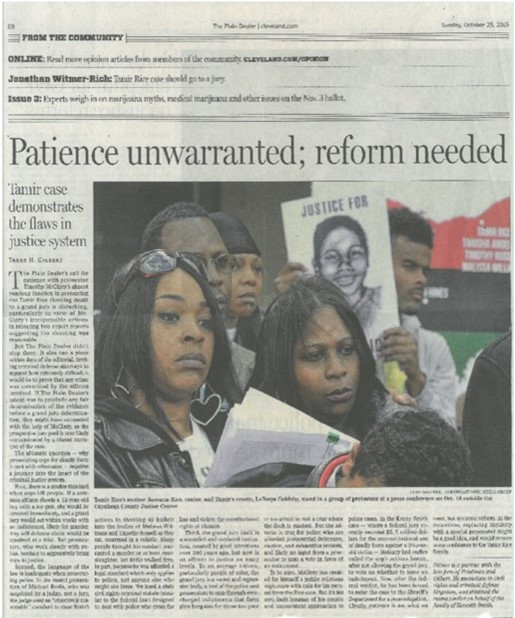
Longtime Cleveland advocate Mariah Crenshaw believes ending the consent decree would lead to regression and a return to unconstitutional policing patterns that led to high-profile deaths, including those of Tamir Rice, Timothy Russell and Malissa Williams. Rice, a 12-year-old Black child, was infamously killed by a Cleveland cop in 2014. Russell and Williams, both also Black, were killed in 2012 after a notorious police chase ended in officers shooting the unarmed duo 137 times.
Without federal oversight, no internal or local mechanisms are strong enough to prevent the department from reverting to past practices, Crenshaw said.
“Community policing strategies such as officers walking beats and officer engagement are not happening,” Crenshaw said.
A broader political context
RECOMMENDED
Have Cleveland police consent-decree terms all been met?
No. Accountability may now fall to citizens:
Eric Foster Feb. 25, 2026, 5:46 a.m.
Why is Cleveland’s mayor, who campaigned on police reform, killing the consent decree?
Feb. 21, 2026, 7:00 a.m.
Hardaway also suggested the timing of the city’s motion may be influenced by the current political climate. During his first term, President Donald Trump characterized consent decrees as overly burdensome on police departments, and several agreements nationwide were scaled back or terminated during that period. Additional agreements have ended under his second term, too.
While Bell Hardaway said Cleveland leaders may have long wanted to end the decree, she questioned whether the present posture of the DOJ made the filing more feasible now than under prior administrations.
“The consent decree wasn’t just about fixing one issue,” she said. “It was about rebuilding systems to ensure constitutional, accountable policing for the long term. That work, by the city’s own filing, appears incomplete.”
Olivia Mitchell